Filter Presses
Review the plate, feed arrangement, cloth attachment, openings, and cake release requirement alongside the PP decision.
Polypropylene filter cloth is a material option for buyers balancing chemical conditions, equipment fit, woven construction, cake behavior, and replacement details.
Discuss PP Filter Cloth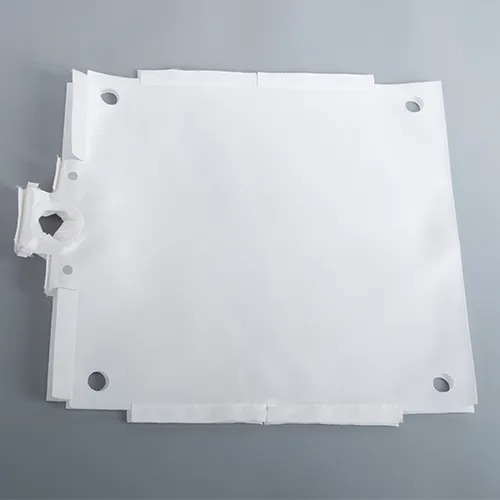
Industry filter-cloth guidance commonly positions polypropylene as a widely used, economical synthetic option when chemical compatibility matters. Review the actual liquid and process for suitability.
Polypropylene, often shortened to PP, is a synthetic fiber material used in industrial filtration media. Buyers commonly consider it when chemical compatibility, broad industrial use, and an economical material option are important priorities.
The useful selection question is: Will this PP construction remain compatible with the liquid, temperature, pressure, cleaning method, and equipment geometry? Review the actual grade, yarn, weave, finishing, and operating conditions against the process specification.
Polypropylene filter cloth is often evaluated for industrial solid-liquid separation where the process team places significant weight on chemical compatibility. Common equipment and process discussions include filter presses, wastewater treatment, chemical processing, and mineral or slurry dewatering. The specific machine, liquid, and construction still determine whether the material is suitable.
Review the plate, feed arrangement, cloth attachment, openings, and cake release requirement alongside the PP decision.
Include sludge composition, chemistry, solids, cleaning, and the required filtrate or cake result in the review.
Identify the actual liquid, concentration, temperature, exposure time, and cleaning chemistry; compatibility follows these conditions, not the industry name.
Particle shape, abrasion, cake handling, and equipment loading may change the preferred yarn, weave, or even the material choice.
PP and PET address different selection priorities rather than a universal better-or-worse choice. PP is often considered when chemical compatibility and a widely used, economical option are central, while PET may be evaluated when temperature tolerance or mechanical and dimensional demands receive greater weight. Check PET chemistry and, where relevant, hydrolysis risk.
| Selection question | Why PP may be considered | Process details to review |
|---|---|---|
| Liquid chemistry | Chemical compatibility is commonly a leading reason to evaluate PP. | Exact chemicals, concentration, temperature, exposure time, and cleaning chemistry. |
| Operating conditions | PP may be a practical option for some general industrial liquid-solid separation duties after reviewing the selected construction. | The actual operating temperature, pressure, cycle, and mechanical loading. |
| Construction | PP can be reviewed in different woven yarn and weave constructions. | Monofilament, multifilament, spun yarn, weave, finishing, and target retention. |
| When PET may deserve comparison | PP is not automatically preferred when temperature or mechanical priorities point elsewhere. | Compare with the Polyester Filter Cloth page using actual process evidence, including chemistry and hydrolysis risk where relevant. |
Material selection does not finish the specification. Yarn design and weave alter surface behavior, particle capture, drainage, cake release, flexibility, and blinding. Use the Woven Filter Cloth page to work through those construction choices.
Monofilament, multifilament, spun, or combined yarn designs create different surface and retention tradeoffs. The correct choice depends on the slurry and cleaning method.
Plain, twill, satin, basket, and other patterns can change stability, flexibility, cake release, and particle retention. Match the weave to the job.
Finishing and heat-setting decisions may influence surface behavior and dimensional stability. Use the finishing specified for the selected construction.
Feed holes, necks, seams, edges, gaskets, eyelets, and fixing details can determine whether the cloth installs and seals correctly.
For an existing machine, the current cloth and its fit are evidence. Record the equipment type, plate or basket dimensions, attachment, feed opening, edge treatment, seam, and any leakage or stretching. If the current PP cloth blinds, releases poorly, wears quickly, or does not seal, include that operating problem in the quotation review.
For drawing-led fabrication, use Custom Fabricated Filter Cloth and include the drawing or sample with the request.
No. Check the actual liquid, concentration, temperature, exposure, construction, and cleaning method.
Start with chemistry and operating conditions. PP may suit a chemistry-led decision; PET may deserve comparison when temperature or mechanical demands receive greater weight. Check PET chemistry and hydrolysis risk where relevant, then verify plate fit, yarn, weave, and cake behavior.
No. PP can be evaluated in different yarn and weave constructions. Select construction around retention, drainage, cake release, cleaning, and equipment load.
A photo helps identify the equipment and finished geometry; a drawing, measurements, process conditions, sample, or purchase record make the review more reliable.
Send the chemistry, equipment, current cloth, and operating problem. The review can compare PP material, yarn, weave, and finished fit rather than only a material name.