
Filter Presses
Plate type, feed arrangement, attachment, openings, and gasket or edge details determine the replacement fit. See Filter Press Cloth.
Choose filter cloth by equipment, woven construction, material, and replacement or fabrication requirements. Start with the job the cloth must perform, not only the fiber name.
Discuss Your Requirement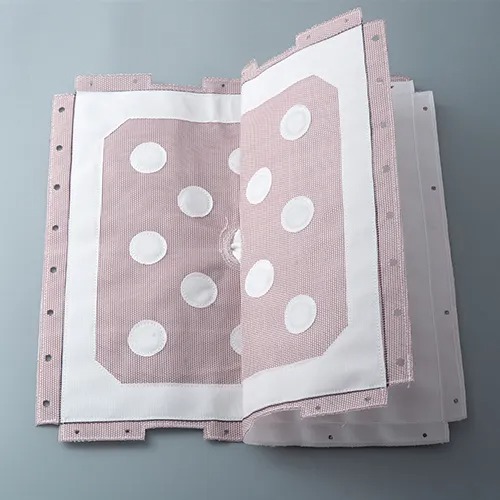
Start with the main question in your purchase or replacement project.
Industrial filter cloth is a porous textile used for solid-liquid separation. Liquid passes through while suspended solids form a cake, so the cloth affects filtrate clarity, drainage, cake release, cleaning, and cycle reliability. Fiber material, yarn, weave, finishing, permeability, attachment, and geometry must be considered together; a cloth suitable for one machine or slurry may not suit another.
Different equipment types impose different fit and operating questions. Confirm the machine before choosing or quoting a cloth; final compatibility and supply scope depend on the drawing and process.
Plate type, feed arrangement, attachment, openings, and gasket or edge details determine the replacement fit. See Filter Press Cloth.
Rotating equipment adds geometry, support, drainage, and mechanical loading questions. See Centrifuge Filter Cloth where relevant.
Continuous dewatering and vacuum equipment use a separate belt product family. See Filter Belts rather than treating every belt as a press cloth.
For an operating machine, the old cloth, drawing, plate details, and problem are useful starting evidence.
Choose material and construction together. Polypropylene and polyester can lead to different priorities for chemistry, temperature, mechanical loading, and cake behavior; woven construction adds yarn and weave choices that affect retention, drainage, blinding, and cake release.
Often considered when chemical compatibility and an economical synthetic option matter. Confirm the actual chemistry and operating conditions.
Often evaluated when temperature tolerance or mechanical and dimensional demands matter more. Confirm liquid chemistry and operating conditions.
Yarn filament type and weave pattern change the balance between particle capture, cake release, flexibility, stability, and blinding.
Nylon, PPS, aramid, PTFE, and other fibers may suit other filtration or dust-collection needs. Ask if the process requires another material.
Define equipment, separation result, material, and construction together; a fiber name is not a complete specification.
Identify filter type, plate or basket dimensions, feed, attachment, openings, seams, and gasket or edge requirements.
Provide liquid chemistry, solids, particle shape, concentration, temperature, and whether cake or filtrate is the priority.
Clarify filtrate clarity, drainage, cake dryness and release, cycle time, cleaning, and blinding.
Consider pressure, flexing, abrasion, scraping, washing, backflushing, cycle frequency, and retained cake weight.
A replacement may need an exact outline, feed opening, neck, seam, reinforcement, gasket, eyelet, tie, or other attachment detail. The construction must suit installation, support, cleaning, and machine loads. For a drawing-led or sample-led project, see Custom Fabricated Filter Cloth and provide the existing part or drawing.
Filter cloth questions arise in mining and mineral processing, chemical processing, wastewater treatment, power and energy, cement, and metallurgy. The process context helps, but equipment drawings and slurry information still guide selection.
Review particle size, abrasion, cake handling, and dewatering equipment.
Review liquid chemistry, temperature, solids, and cleaning together.
Review sludge properties, filtrate clarity, cycle behavior, and fit.
Review fine or abrasive solids and the required cake or filtrate result.
For a useful quotation review, send as many of the following as are available:
No. Material, yarn, weave, finishing, equipment fit, attachment, slurry, and the desired separation result all interact.
Start with Filter Press Cloth when the machine is the main constraint. Start with PP or PET when material is the main question, then confirm fit.
A drawing, sample, photos, and attachment details are the right starting evidence. Final fabrication details must match the specification.
Send old cloth, machine information, process conditions, and any label or purchase record. Verify the material rather than guessing from appearance.
Send the equipment, slurry, separation result, and existing cloth evidence. This information helps review the appropriate material and construction.